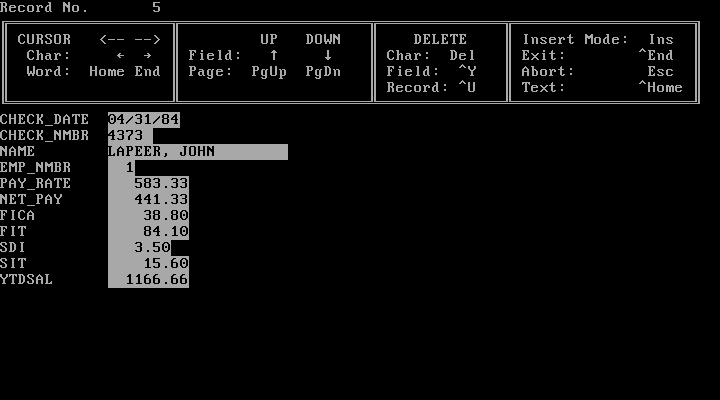
In the early 2000s, my junior high school years became the foundation of a lifelong journey in programming. While many of my classmates were still learning the basics of typing in WordStar or calculating in Lotus 1-2-3, I was already experimenting with scripting, automation, and database programming. Each year brought a new layer of understanding, culminating in my first true breakthrough with dBASE III Plus in 2001 — a powerful environment that gave me the confidence to build complete systems.
2000 – DOS Batch Scripting: Custom Interfaces from the Ground Up
My journey began in 2000 with the humble world of DOS batch scripting. Using nothing more than text files and the built-in AUTOEXEC.BAT functionality, I learned how to create custom user interfaces that greeted the system at startup.
- I experimented with menus, prompts, and branching logic.
- I discovered how simple commands could be chained together to automate workflows.
- Most importantly, I realized that even the operating system itself could be shaped to reflect my ideas.
This was my first taste of system-level customization — bending the computer to my will, rather than just following instructions.
2000 – Lotus 1-2-3 Macro Scripting: Automating Calculations
Later that same year, I moved into Lotus 1-2-3, the spreadsheet giant of its time. Beyond formulas, I discovered the power of macro scripting.
- I wrote macros to automate repetitive tasks and calculations.
- I learned how to structure workflows so that the spreadsheet became more than a static grid — it became a dynamic tool.
- This taught me the principle of automation: letting the computer handle the routine so I could focus on creativity.
Lotus 1-2-3 scripting showed me that even productivity software could be programmed, and that logic could live inside everyday tools.
2001 – dBASE III Plus: The First Breakthrough
By 2001, I had stepped into something far more powerful: dBASE III Plus. Unlike DOS batch or Lotus macros, dBASE wasn’t just about automating tasks — it was about building complete applications.
Crafting My Own UI
With dBASE III Plus, I designed text-based menus navigable by arrow keys. Each menu led to modules that felt like professional software. Even in a purely text-based environment, I learned that user experience mattered.
From CRUD to Creativity
Assignments that asked for simple data handling became opportunities to explore:
- CRUD applications: I built programs to manage my friends’ information, storing names, birthdays, and personal notes, with routines to add, update, and delete entries.
- Weton analysis: I wrote programs that calculated and interpreted the traditional Javanese weton of my classmates, blending cultural heritage with programming logic.
- Text-based mini-games: I experimented with branching menus and conditional logic to create playful experiences, proving that even a database language could be fun.
Confidence Through Understanding
While my classmates clung to their notes, I jumped in with confidence. I had already grasped the core of programming: logic, data, and flow. That understanding gave me freedom — the freedom to improvise, to extend beyond the assignment, and to make something uniquely mine.
The History Behind dBASE III Plus
To understand why dBASE III Plus was so transformative, it helps to look at its history:
- Vulcan (1978): Created by Wayne Ratliff, Vulcan introduced the
.dbffile format and a command-driven environment. - dBASE II (1980): Licensed by Ashton-Tate, it became the first commercial success, marketed as “version II” to appear mature.
- dBASE III Plus (1985): The breakthrough version, combining a database engine, query system, forms engine, and programming language. Developers could build complete applications without external tools.
- Market dominance: By the mid-1980s, dBASE held nearly 70% of the microcomputer database market, spawning the xBase ecosystem (Clipper, FoxPro, Paradox).
- Legacy: Even after SQL-based systems took over, the
.dbfformat remained in use, and the philosophy of tightly coupling a language with its database inspired later tools like Microsoft Access and SQLite.
This history explains why dBASE III Plus felt so powerful in 2001. Even though it was already considered “old” by industry standards, for me it was a gateway into professional-grade programming.
Reflection
Looking back, the timeline of 2000–2001 shows a clear progression:
- DOS batch scripting taught me system-level customization.
- Lotus 1-2-3 macros taught me automation.
- dBASE III Plus taught me application design, user experience, and confidence through understanding.
Together, these experiences formed my first breakthrough. They showed me that programming is not about memorizing syntax, but about designing workflows, serving users, and turning ideas into living systems.
2001 was the year I stopped being a student of notes and became a builder of worlds. And at the center of it all was dBASE III Plus, the language and environment that transformed my curiosity into confidence.